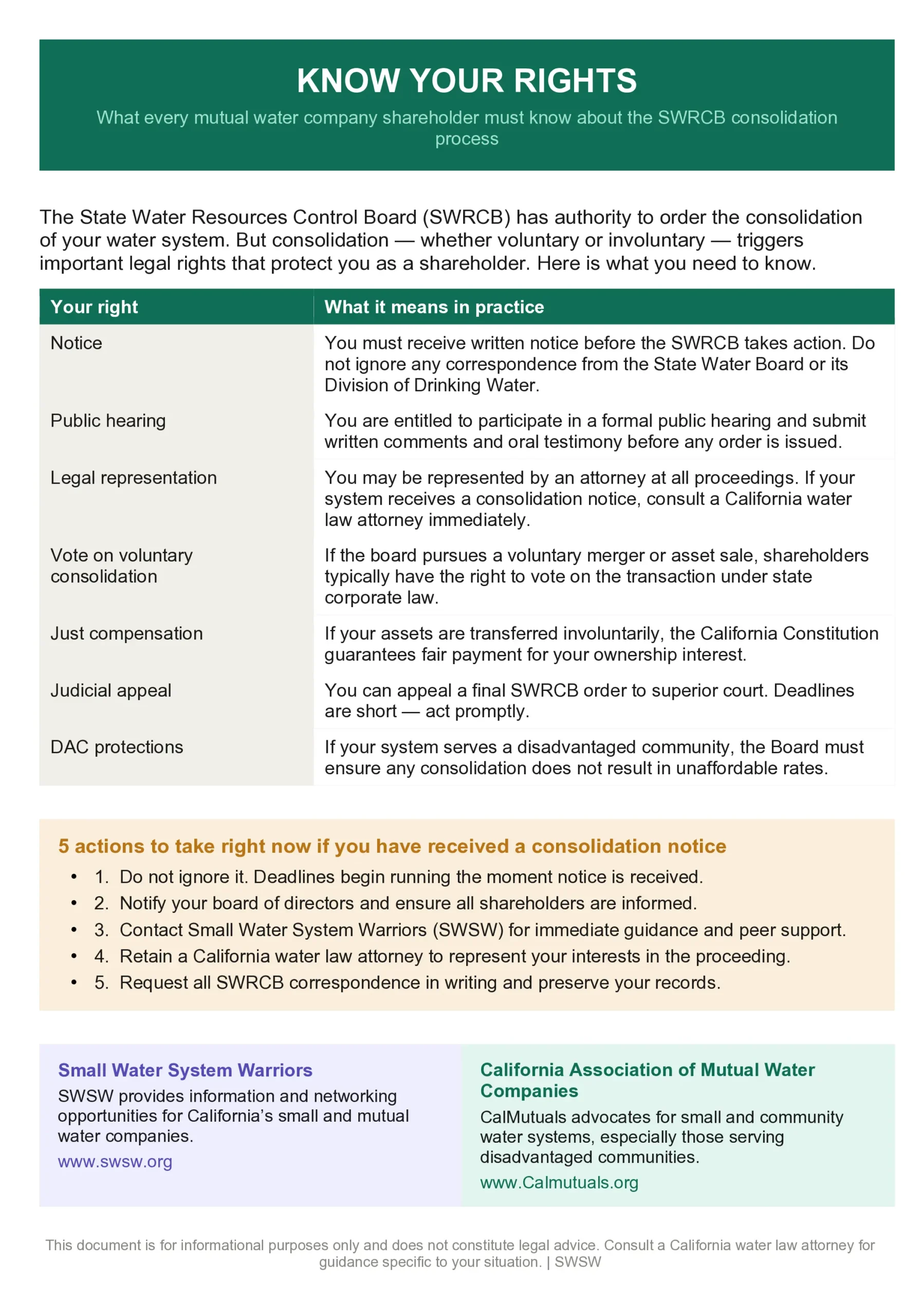
Know Your Rights
A Guide for Mutual Water Company Shareholders Facing SWRCB Consolidation Proceedings
Your rights. Your water. Your voice.
As a shareholder of a California mutual water company, you hold a unique form of ownership — one tied directly to your access to water and your standing in the community your system serves. California law recognizes and protects those rights, not only in the daily governance of your company, but especially during any proceeding initiated by the State Water Resources Control Board (SWRCB) to consolidate your system with another water provider.
This section explains what you are entitled to know, to say, and to do — at every stage of that process.
Your rights in ongoing governance
Mutual water companies are organized either under the general corporation law or under California’s Mutual Benefit Corporation law (Corporations Code §§7000 et seq.). As a shareholder or member, you have the right to:
- Vote to elect and remove directors from the board
- Vote on amendments to the company’s articles of incorporation and bylaws
- Approve major decisions such as mergers, dissolutions, or the sale of significant assets
- Call or petition for a special shareholders’ meeting (generally requires 5% or more of outstanding shares)
- Receive an annual financial report
- Inspect the shareholder list, board minutes, and accounting records upon written demand
- Receive advance notice of all shareholder meetings and any proposed actions
- Have your water service delivered in proportion to the shares or membership interests you hold, and participate in rate and assessment discussions
Your rights if the SWRCB initiates a consolidation proceeding
The SWRCB has statutory authority under Health & Safety Code §§116681–116686 to order the consolidation of a water system it determines the system is failing to provide adequate, safe, or reliable service. This authority is significant — but it comes with meaningful procedural protections for shareholders.
Before any consolidation order can be issued, you have the right to:
- Receive written notice of the SWRCB’s intent to initiate a consolidation review
- Participate in a public hearing before the Board takes any action
- Submit written comments and oral testimony into the official record of the proceeding
- Be represented by legal counsel at all Board hearings and proceedings
- Demand that the Board make formal findings that consolidation is in the public interest, technically feasible, and financially sound
- Request reconsideration of a Board order before seeking court review
If the SWRCB orders consolidation and your interest in the company’s assets is transferred without your consent, the California Constitution (Article I, Section 19) guarantees just compensation if the consolidation involves a transfer of the company’s assets to a public agency. Additionally, any final consolidation order must define the service obligations and governance commitments of the receiving water system before it becomes effective.
If you are not satisfied with the Board’s decision, you have the right to seek judicial review in superior court under Water Code §13330.
California Association of Mutual Water Companies (CalMutuals)
CalMutuals provides regulatory, legislative, and technical advocacy for California’s mutual water companies and small water systems. Resources include legal referrals, regulatory guidance, and peer connections with systems that have navigated this process.
www.CalMutuals.org
Disadvantaged community protections
If your mutual water company primarily serves a disadvantaged community (DAC), additional legal protections apply. California’s Human Right to Water (Water Code §106.3) requires state agencies to consider affordability and equity when making consolidation decisions. The SWRCB must give heightened weight to the needs of DAC residents and is required to ensure that any consolidation does not result in unaffordable rates or a loss of service for low-income customers.
How Small Water System Warriors and CalMutuals can help
Small Water System Warriors (SWSW) provides informational and networking support for small water systems and mutual water companies. CalMutuals directs technical and advocacy support to member systems involved in or threatened by SWRCB consolidation proceedings. Our resources include legal referrals, regulatory guidance, peer connections with systems that have navigated this process, and direct representation before the Board and the Legislature.
If you have received a notice of a consolidation inquiry, or if you believe your system may be targeted, contact us before the process advances.
Shareholder FAQ: SWRCB Consolidation & Your Rights
What triggers a SWRCB consolidation review of my water system?
The SWRCB may initiate a consolidation review when it determines that a water system is failing — or at risk of failing — to consistently provide safe, reliable, and affordable drinking water. Common triggers include repeated violations of drinking water standards, chronic complaints about water quality, financial insolvency or inability to maintain infrastructure, and inadequate management capacity. Oftentimes, these deficiencies result from the water system’s financial limitations and inability to generate the substantial amounts necessary to install treatment facilities through shareholder or member assessments. Being placed on the SWRCB’s list of at-risk systems does not automatically mean consolidation will be ordered, but it does signal that the Board is watching.
Will I be notified before any consolidation action is taken?
Yes. The SWRCB is required to provide written notice to the water system and its shareholders before initiating formal consolidation proceedings under Health & Safety Code §116682. That notice must describe the basis for the State Water Board’s concern and give you the opportunity to respond. Shareholders should ensure their mailing address on file with the company is current so they receive all required communications.
Can shareholders stop a consolidation proceeding?
Shareholders can contest a proceeding but cannot unilaterally block it. The most effective strategies are: (1) demonstrating to the SWRCB that the system’s problems have been corrected or have a credible remediation plan; (2) engaging in a voluntary consolidation negotiation with a preferred receiving agency before the SWRCB acts; or (3) challenging the State Water Board’s findings in a formal hearing or through judicial review. SWSW has experience supporting systems in each of these approaches.
What happens to my shares if the system is consolidated?
In a voluntary consolidation, shareholders typically receive a negotiated settlement — either a buyout of their shares or an exchange for membership or ownership interests in the receiving agency, depending on its legal structure. In an involuntary consolidation ordered by the SWRCB, the California Constitution’s just compensation guarantee applies to any taking of private property. Shareholders should retain independent legal counsel to ensure their interests are protected in any asset transfer.
Can shareholders vote on whether to accept a consolidation?
In a voluntary proceeding, yes — a consolidation that involves a merger, dissolution, or major asset sale typically requires a shareholder vote under applicable Corporations Code statutes. In an involuntary SWRCB-ordered consolidation, the Board may act without a shareholder vote, but must still make required public-interest findings and provide due process. This is one of the key reasons early engagement in the voluntary process is so important.
What is 'just compensation' and how is it calculated?
Just compensation is the constitutionally required payment when the government takes private property — in this case, your ownership interest in the water system. It is generally measured by the fair market value of the property at the time of the taking. Determining fair market value for a mutual water company can be complex, as it may involve the value of water rights, infrastructure, customer base, and long-term service revenue. An independent appraisal of the water system and your proportionate interest in that system is strongly recommended before any asset transfer is finalized.
My system serves a low-income community. Does that change anything?
It strengthens your protections. If your system primarily serves a disadvantaged community, the SWRCB must give special consideration to affordability and equity under Water Code §106.3 (the Human Right to Water). The Board may not impose a consolidation that results in unaffordable rates for low-income residents. Additionally, the receiving system must commit to maintaining service and keeping rates affordable as a condition of any consolidation order.
Can I appeal a SWRCB consolidation order?
Yes. You may first request reconsideration by the State Water Board itself (Cal. Code Regs. tit. 23, §768). If the State Water Board upholds its order, you can seek judicial review in the superior court under Water Code §13330. Court challenges typically focus on whether the State Water Board followed required procedures, whether the public-interest findings were supported by evidence, and whether just compensation was provided. Legal deadlines for seeking review are short — consult an attorney promptly after receiving any final order.
Where can I get help?
Contact Small Water System Warriors directly. We can connect you with member systems that have been through this process, refer you to attorneys who specialize in California water law, and provide regulatory guidance on your rights at each stage. Do not wait until a hearing is scheduled — the earlier you engage, the more options you have.